You fit out a van in seven steps: map out your work, measure your load space, choose your modules, secure your load, protect the floor and walls, make use of the roof and have everything professionally installed. If you stick to that order, you avoid expensive mistakes and get the most out of every cubic metre of load space. In this guide we walk you through each step, with practical tips from our specialists, whom more than 5,000 tradespeople already trust.
1. Map out your work
The first step towards a good van fit-out is an inventory of your work. Which tools do you carry every day? What sits unused at the back for months? Which small items do you keep losing? That inventory decides which modules you really need and stops you paying for storage you never use.
Think about your work routine too. An electrician wants cable reels and measuring equipment close at hand, a joiner carries long profiles and heavy machine tools. The ideal layout differs a lot from trade to trade, so always start from your daily practice.
Did you know that tradespeople lose up to 30 minutes a day on average searching for tools? A well-thought-out layout often pays for itself within a year in working hours saved.
2. Measure your load space accurately
Measure the length, width and height of your load space at several points, because a load space is rarely perfectly rectangular. Every make and model also has its own wheel arches, heights and fixing points. A made-to-measure fit-out takes all of that into account, so you don't waste a single cubic centimetre.
Not sure? We have measurements for just about every common model, from the Renault Trafic to the Mercedes-Benz Sprinter. That way you know straight away what fits.
3. Choose your modules and cabinets
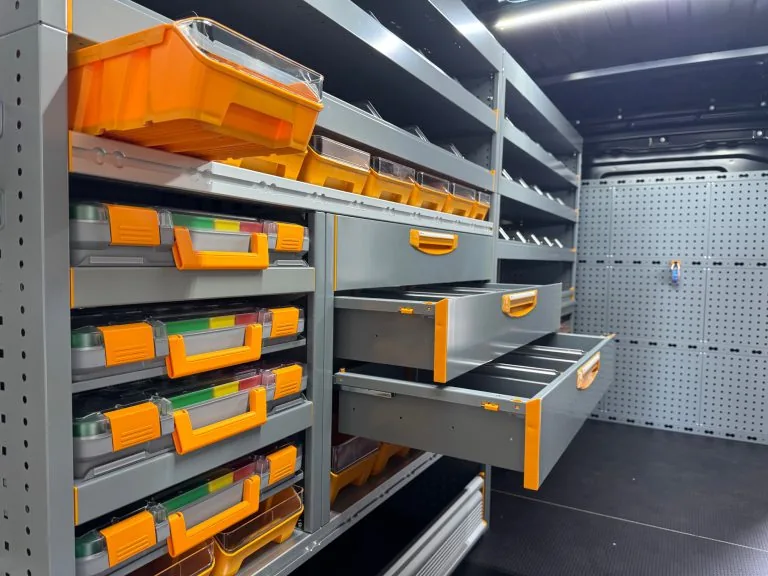
You choose your modules based on your inventory: drawers for small items, shelves for cases and boxes, and open space for whatever varies in size from day to day. A modular storage system also grows with your work. What matters is that heavy material sits low and close to the axles, so your van stays stable on the road.
When choosing, pay particular attention to these points:
- Heavy, frequently used tools go at hip height, so you don't have to bend down.
- Keep small items in lockable drawers, not in loose boxes that tip over.
- Allow open space for material that varies in size from day to day.
- Choose a system you can extend later when your business grows.
Think about the material too. If you choose aluminium, your fit-out is up to 30% lighter. If you drive electric, that lower weight translates directly into more range for your electric van. Still undecided? In our article aluminium or wood for your fit-out we compare both materials side by side.
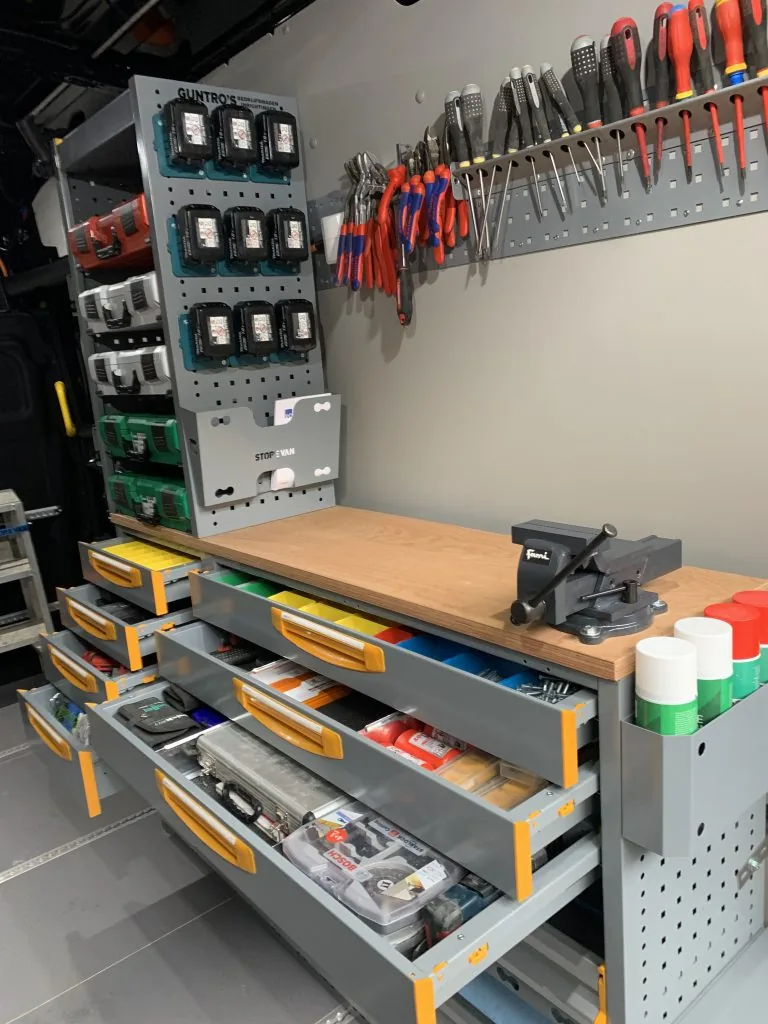
For many tradespeople, a mobile workbench is the unsung hero of the fit-out: you work standing up in your van instead of bent over the bonnet.
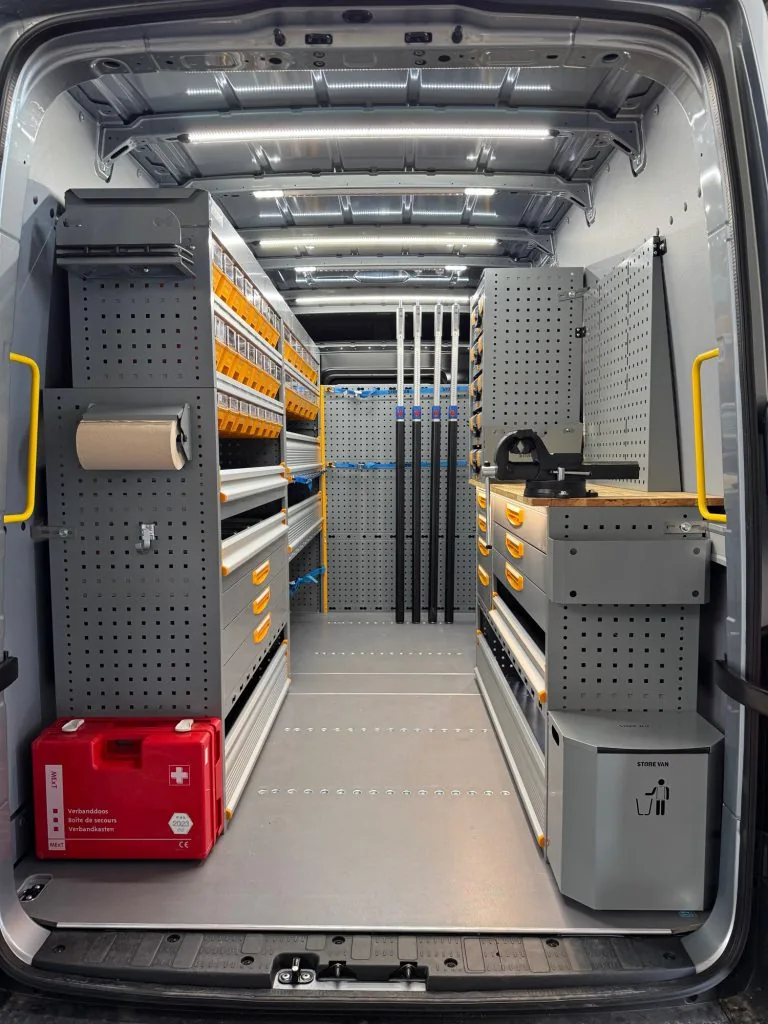
- What is a complete fit-out?
- A complete fit-out is a full, made-to-measure build in which modules, floor, walls, load securing and lighting are matched to each other. The opposite of a loose cabinet that you put in yourself.
4. Think about load securing
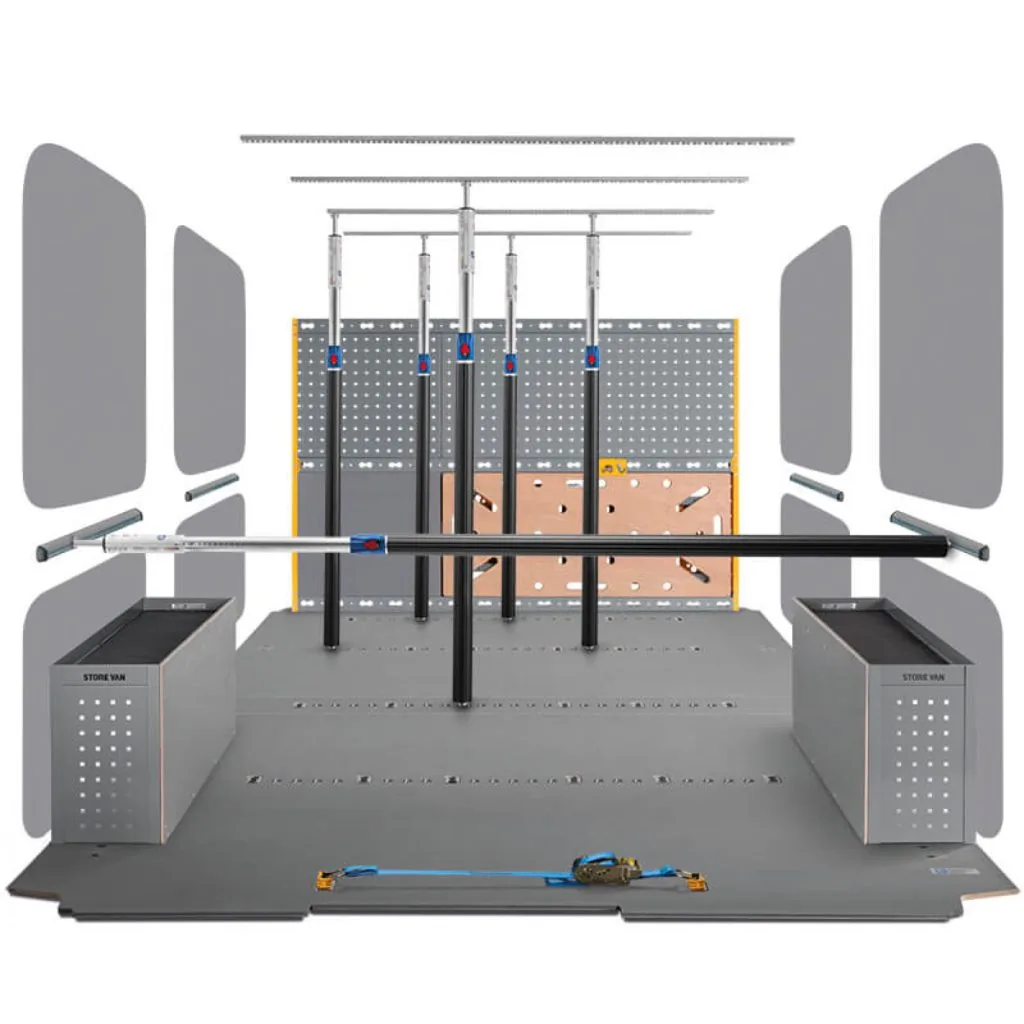
Load securing makes sure nothing comes loose when you have to brake hard. At 50 km/h a loose drill becomes a projectile with the impact of hundreds of kilos. With lashing bars, straps and a TÜV-certified bulkhead, you hold heavy loads firmly in place. The European directive 2014/47/EU sets out how strong that anchoring must be. On the page about load securing for your van you will find all the options, and in our article about Belgian law on load securing you can read exactly what an inspection expects.
Did you know that, according to the European Commission, loose or poorly secured loads are involved in 25% of road accidents with commercial vehicles? Securing your load is not paperwork, but self-protection.
In an emergency stop, an unsecured load flies towards the cab with full force. A bulkhead is your last line of defence.
5. Protect the floor and walls
Sturdy floor and wall lining protects the sheet metal of your load space against dents, scratches and, eventually, rust. That keeps your load space like new for years. You notice it when you trade in: a well-kept load space keeps the resale value noticeably higher.
6. Make use of the roof and height
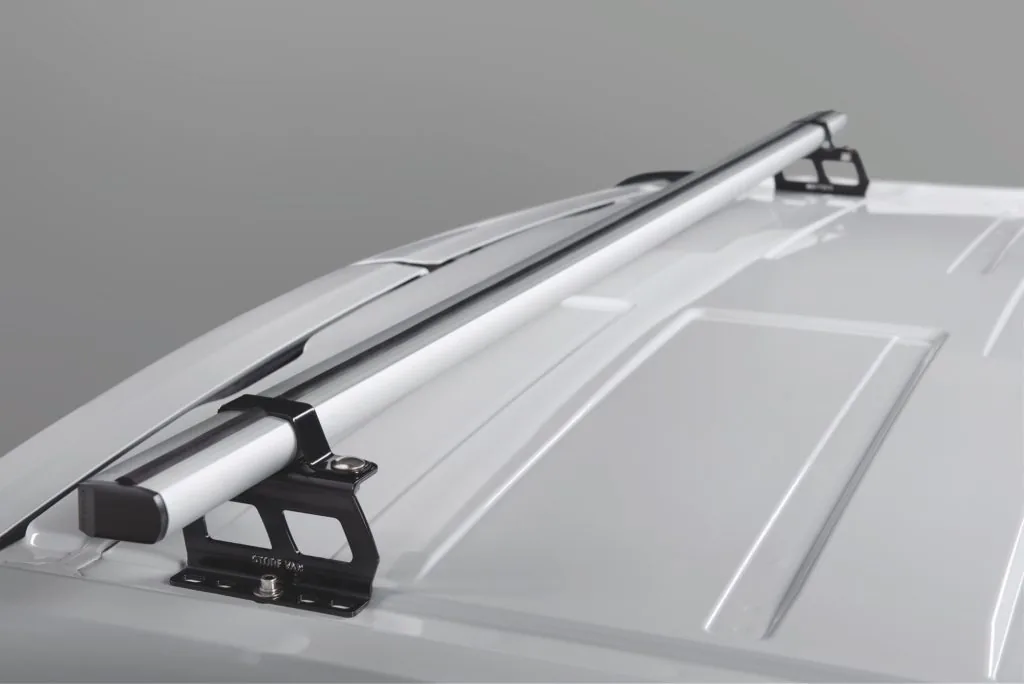
Long materials such as ladders and pipes are safest on the roof, not loose in your load space. With roof racks, optionally with integrated LED lighting that shines up to 5 metres around your vehicle, you load safely and work comfortably in the dark too. Inside, vertical modules give you extra storage space from the same van.
7. Installation and maintenance
The last step is professional installation and regular maintenance. Below is the short version of a smooth installation:
Plan your appointment
Drop off your van empty. We schedule the installation shortly after your vehicle is delivered.
Professional installation
The modules are fixed to the original mounting points, without weakening the bodywork.
Check and explanation
You get a tour of your new fit-out, including tips for everyday use.
Maintenance
Keep drawers and locks clean and lubricated. That way your fit-out will last the whole life of the van.
What does fitting out a van cost?
The price of a van fit-out depends on three factors: the size of your vehicle, the material of your modules and the make-up of your fit-out.
- Size of your vehicle: the larger the load space, the more lining and modules you need.
- Material: steel, aluminium and wood differ in weight, lifespan and price.
- Make-up: from a few drawers to a complete fit-out with workbench and roof rack.
That is why there are no fixed package prices: every fit-out is put together to suit your work. Want an exact figure for your van? Request your free bespoke quote with no obligation.
Remember this: fitting out a van in 7 steps
- Always start from your daily work, not from a catalogue.
- Heavy, frequently used tools get a fixed place at hip height.
- Load securing and a bulkhead are basic safety, not an option.
- Protect the floor and walls from day one: you will see it in the resale value.
Ready to fit out your own van? Request your free bespoke quote with no obligation and you will know where you stand. That way you start step one with a clear plan and a clear budget.